Interim Report January 1 - June 30, 2026
April 1 - June 30
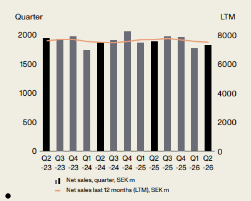
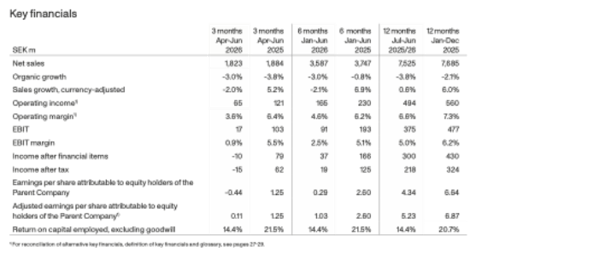
- Net sales amounted to SEK 1,823 m (1,884), corresponding to a decrease of 3.2%. Adjusted for exchange rate changes, net sales decreased by 2.0%, mainly due to temporarily limited delivery capacity in connection with the ramp-up of the Group’s external logistics setup.
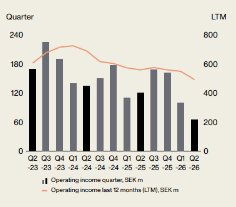
- Operating income amounted to SEK 65 m (121) and was negatively impacted by lower sales volumes as well as increased costs related to the logistics transition. The outcome is in line with previously communicated preliminary information in the press release on June 12, 2026.
- EBIT was negatively impacted by restructuring costs related to a new efficiency program in sales and administration as well as items affecting comparability incurred for unused part of the new external warehouse.
- Earnings per share attributable to the Parent Company’s shareholders amounted to SEK -0.44 (1.25).
Interview with the CEO
How would you summarize the second quarter?
The second quarter was characterized by operational disruptions in connection with the ramp-up at our external logistics partner. The change is an important part of our work to create a more efficient and scalable logistics structure, but the implementation has been challenging. The disruptions led to both reduced delivery capacity and increased costs.
What impact have the implemented logistics changes had on operations?
The impact has been significant. The limited outbound delivery capacity meant that we were unable to fully meet demand and thereby maintain the service level we strive for. The focus has therefore been on stabilizing operations and improving delivery flows. An important decision during the quarter was to postpone the relocation of distribution for the German market which created better conditions for stabilizing operations.
We see improvements toward the end of the quarter and the work to ensure a stable and reliable delivery capability continues with the highest priority.
Which factors were decisive for income development in the quarter?
The deviation is primarily explained by delivery disruptions, which resulted in both lost sales and increased costs in the form of dual inventories and more expensive transport solutions. The situation has gradually improved during the first few days of July, although operations have not yet fully normalized. At the same time, the reduction of outstanding backorders is contributing positively to earnings and helps offset the remaining inefficiencies that continue to affect operations. Overall, the financial impact in the third quarter is expected to be significantly lower than in the second quarter.
Development in the Middle East was particularly weak during the quarter due to geopolitical factors negatively affecting travel and tourism.
In Germany, both sales and income developed in line with the previous year, despite a weak market. Distribution to the German market has not yet been transferred to the new logistics setup and has therefore not been affected by the disruptions that had a significant impact on other European markets. At the same time, our cost-saving measures from the previous year continue to have an effect and help to partly offset the impact. Work to adapt the cost base and strengthen efficiency in operations continues.
How did the work on the Group’s long-term growth initiatives progress during the quarter?
In parallel with addressing the operational challenges, we continue to drive our strategic initiatives. Within Food Packaging Solutions, the integration of the newly acquired company Solserv has started, which will strengthen our offering within machines, service, and solutions for industrial customers. We have also completed the phase-out of added PFAS in the packaging range, meaning that we already meet upcoming regulatory requirements in the EU, and launched new solutions tailored to customer requirements for functionality and ease of use.
Within Dining Solutions, the establishment of our modular lighting platform, d.ls – Duni Lighting Solutions, is ongoing. The solutions have been presented at industry and design events ahead of the upcoming launch and have been well received by customers.
What are the most important priorities for the coming period?
The highest priority is to ensure a stable and predictable delivery capability. Together with our logistics partner, we continue the work to strengthen processes, capacity, and operational stability in the existing operations.
We are also taking further measures to strengthen competitiveness in a continued uncertain market environment. This includes cost savings in sales and administration in Europe, with expected annual savings of SEK 30 m and with full effect from the fourth quarter. We also continue to actively manage product mix and pricing.
Our long-term strategy remains unchanged, focusing on gradually strengthening profitability, cash flow, and competitiveness.
Robert Dackeskog,
President and CEO, Duni Group
Contact information
For additional information, please contact:
Magnus Carlsson, EVP Finance/CFO, +46 40-10 62 00, [email protected]
Petra Lamorell, Interim Head of Communications, +46 76-874 03 87, [email protected]
Duni AB (publ)
Box 237
201 22 Malmö, Sweden
Telephone: +46 40 10 62 00
www.dunigroup.se
Registration no. 556536-7488